




Once you cold ferment your pizza dough, you’ll never go back! This 72 Hour Pizza Dough first has you proof the dough at room temperature, then it’s transferred to the fridge to finish fermenting. During this long fermentation process, the yeast slowly feeds on the flour and water, releasing CO2 and creating lots of glorious air bubbles.
This easy recipe delivers a shatteringly crispy exterior, with a perfectly chewy and balanced interior. This is the BEST pizza dough recipe you’ll ever make!
Table of contents
Cold Fermented Pizza Dough Is SO Much Better Than Store-Bought
I was once like you, a Trader Joe’s pre-made-dough-purchasing kind of gal. But after making this 72 hour cold ferment pizza dough, I can never go back. It’s just too easy to make restaurant-quality pizza crust at home — provided you plan ahead, that is.
This simple recipe was inspired by Ken Forkish’s book Flour, Water, Salt, Yeast in the method, but over time I have tweaked it to be my own. The reason this process takes 72 hours is because the yeasty flavor and crispy, chewy texture is developed over that time period.
(And don’t worry, I’ve also given instructions on how to freeze the pizza dough if waiting three full days every time a pizza craving hits doesn’t sound fun to you!)


Need pizza dough now? Make my same-day pizza dough recipe if you need pizza ASAP.
Special Equipment You’ll Need
The 3 Key Ingredients for Pizza Dough
- Flour. As the main ingredient in pizza dough, the flour you use is pretty damn important. I use a combination of 00 flour and all purpose flour. (Use a good all purpose flour though! I’m a fan of King Arthur.) If you don’t want to use the 00, you can use all AP flour, but in my opinion the combination of the two really is something special. Whatever flour you use, make sure it’s great quality.
- Yeast. I always make this refrigerator pizza dough with active dry yeast. It normally needs to be mixed with warm water and set aside to become foamy before being added to the dry ingredients, but since this recipe has such a long fermentation period we can skip this step and add the yeast straight to the mixing bowl.
- Salt. You’ll be adding over a tablespoon of salt, which sounds like a lot but remember that you’ll be seasoning more than 6 cups of flour. I promise the pizza dough won’t taste salty, it will just be yeasty and flavorful!
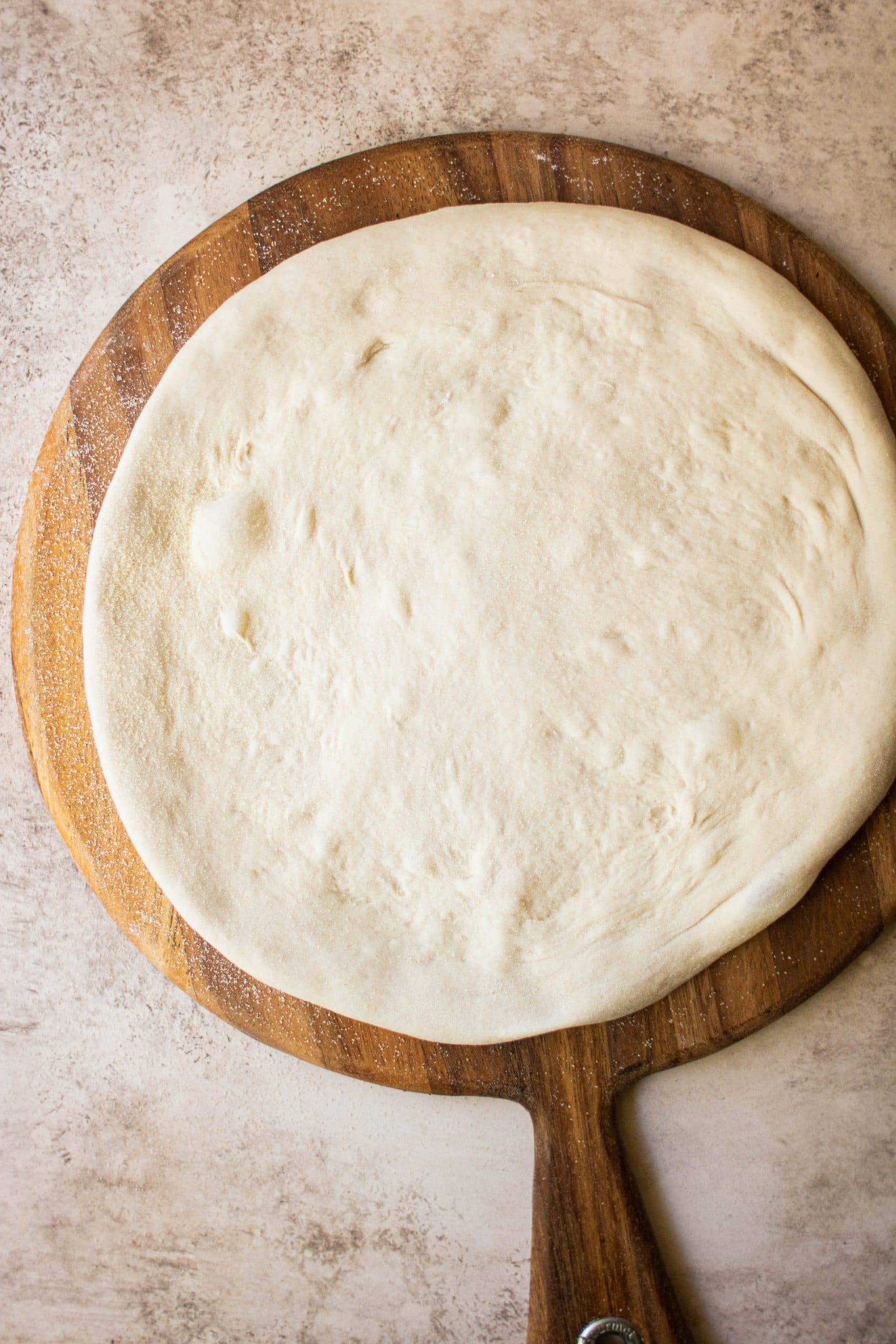
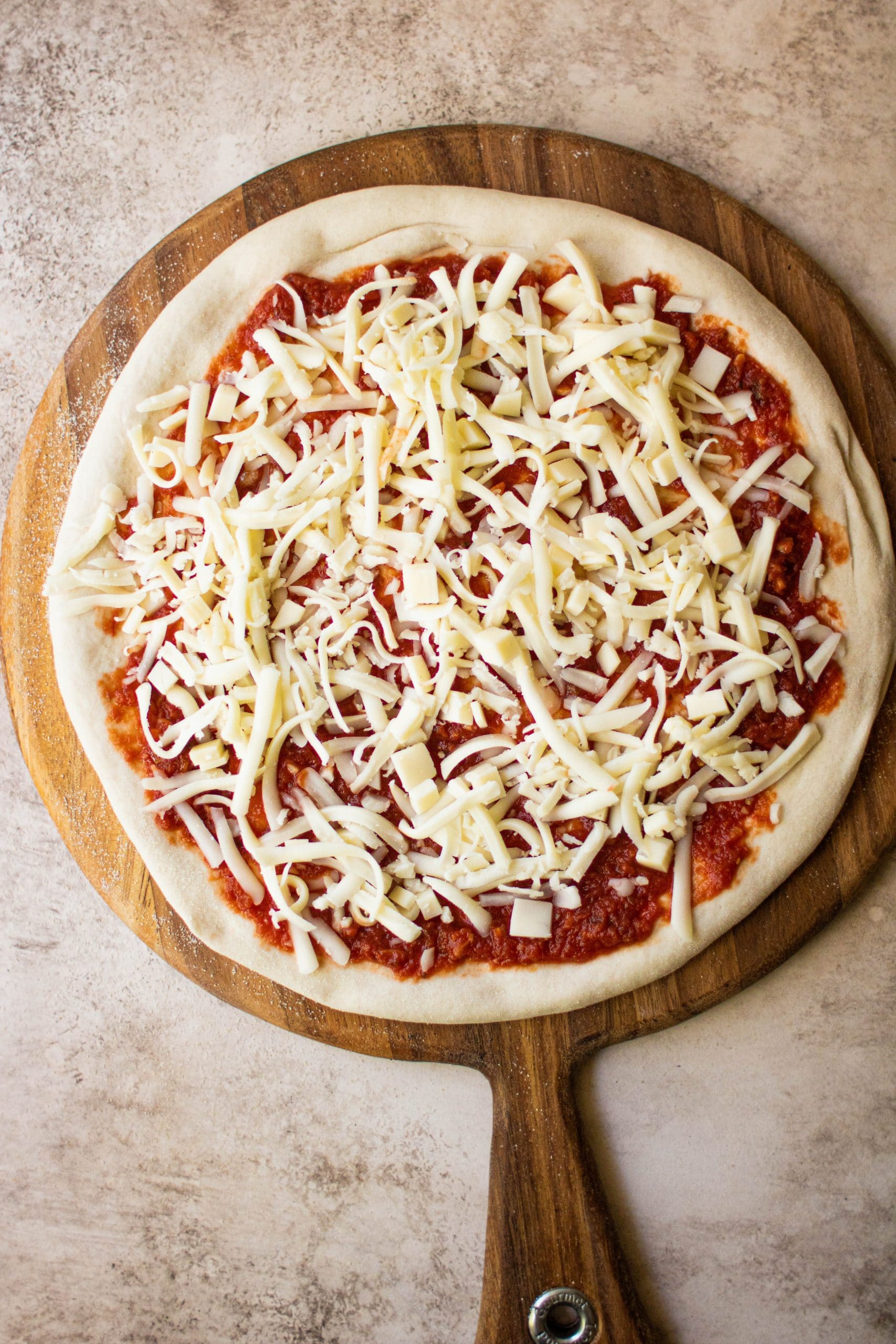
How to Make 72 Hour Pizza Dough
- Mix together the flour, yeast, salt and warm water. This can be done in a stand mixer with a dough hook and mixed for about 5-10 minutes or mixed by hand in a bowl. The dough will still be sticky, but that’s okay.
- Cover and let rise at room temperature for 12 hours. I have a plastic 6-quart container that I use precisely for this application and it’s a lifesaver! You can also use a large kitchen bowl covered with plastic wrap or a container with a lid (covering the dough keeps it from drying out), just keep in mind that the dough will grow very large in size so the container will need to be large enough to accommodate that expansion.
- Transfer to the fridge and ferment for up to 60 hours. I always divide the big ball of dough into four smaller balls, coat them with non-stick spray to prevent a tough skin from forming, then wrap in plastic wrap and refrigerate.
Jenny’s Tip: After the cold fermentation process is finished, you have the option to either bake the the pizza dough or freeze it for later.
- Stretch the dough. DO NOT ROLL YOUR PIZZA DOUGH OUT. All those lovely bubbles that we built up during fermentation will have been for absolutely nothing. The best method is to gently stretch the dough into a rough circle. It doesn’t need to be perfect, it can be oval or whatever shape comes up as you’re stretching the dough. Stretch it as thin as you like to meet your personal tastes.
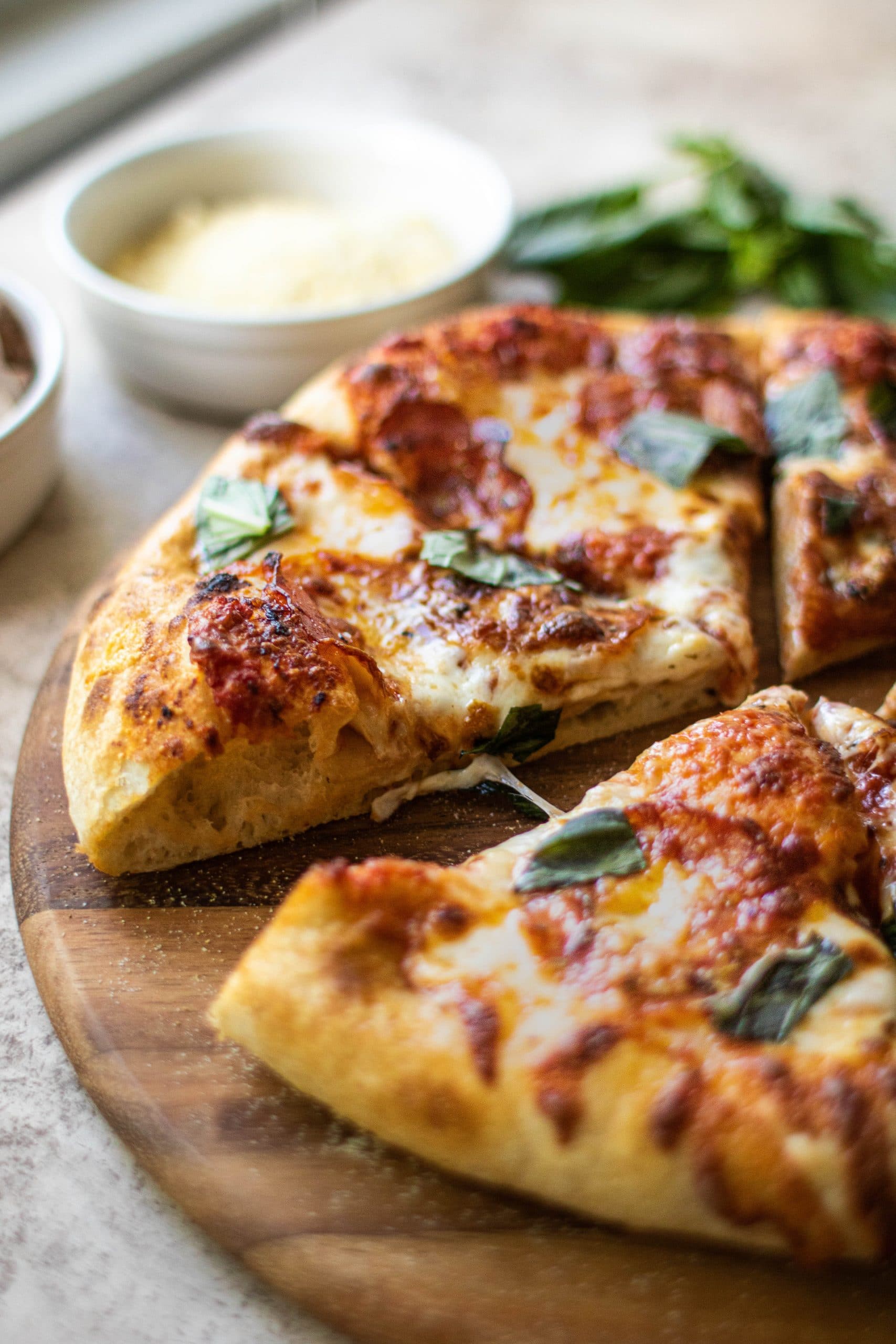
- Top and bake (detailed instructions below!). The toppings at this point are totally up to you, and it’s so fun to make this pizza your own. Keep it simple and make a margherita pizza. Or a white pizza. Or a freakin’ cheeseburger pizza. Who am I to tell you how to live your life? The pizza I have pictured is topped with a simple pizza sauce (recipe below), my special 3-cheese blend, spicy pepperoni, and fresh basil from my garden.

Want This Pizza Dough in Less Than 72 Hours? Here’s How
Can you make this cold fermented pizza dough in less than 3 days? Yes!
I’d say the shortest time period would be 12 hours for the first room temperature rise, then 24 hours for the second cold fermentation. The dough truly does get better the longer it sits in the refrigerator!
Jenny’s Tips for Making the Best Homemade Pizza
Use a pizza steel or pizza stone, not a baking sheet. If you are like me and you take your pizza making very seriously, I highly recommend investing in a baking steel. Steel is more conducive to even heat than stone and therefore creates a crust better than even a brick oven could achieve. However, a pizza stone is your next best bet if you’ve got one!
Give your pizza stone or steel adequate time to heat up. I like to preheat my oven about 45 minutes before my first pizza goes in. Once my steel/stone is adequately heated, I switch my broiler on to high and then throw the pizza in the oven.
The broiler gets the top nice and bubbly and browned (you know those brown bits on the cheese are ESSENTIAL), while the steel/stone gets the bottom cooked. I switch back and forth to keep the oven and the steel/stone hot, but I swear I have turned out pizza from my home kitchen that rivals some of the best pizza places I have been to and you can too!

If you do give this recipe a try, be sure to let me know! Leave a comment with a star rating below. Be sure to subscribe to my weekly newsletter and never miss a new recipe! You can also snap a photo & tag @JENNYGOYCOCHEA on Instagram. I LOVE hearing about & seeing your SMF creations!
More Homemade Pizza Recipes
- French Bread Pizza
- Vodka Sauce Pizza
- Grandma Style Pizza
- White Pizza (Pizza Bianca)
- Cast Iron Skillet Pizza
This post may contain affiliate links from which I receive a small commission at no additional cost to you. Affiliate links allow me to keep providing great recipes for free and I never recommend products that I don’t love and personally own.

72 Hour Pizza Dough Recipe
Ingredients
Pizza Dough
- 400 g '00' FLOUR
- 350 g all purpose flour
- 475 g tepid water (around 75ºF)
- 20 g salt
- 3 g active dry yeast (about 1 teaspoon)
Pizza Sauce
- 2 tablespoons olive oil
- 6 cloves garlic, minced
- 1/2 teaspoon dried oregano
- 28 oz can whole peeled tomatoes, crushed by hand
- 2 tablespoons tomato paste
- 1 tablespoon granulated sugar
- 1/2 teaspoon salt
Toppings
- 6 oz whole milk mozzarella, grated by hand
- 4 oz provolone cheese, grated by hand
- 4 oz fontina cheese, grated by hand
- 6 oz freshly sliced pepperoni
- fresh basil leaves
- freshly grated parmesan cheese
- semolina flour, for dusting
Instructions
- Make the pizza dough. Weigh flour, yeast and salt into a large mixing bowl or the bowl of a stand mixer fitted with the dough hook. Add water and mix for 5-10 minutes or until dough is smooth.
- Let rise at room temp. Transfer to a greased container with a lid or a mixing bowl covered with plastic wrap. Let sit in a warm-ish place in the kitchen for 12 hours.
- Portion into 4 balls. After 12 hours, turn the dough out onto a well floured surface. Portion the dough into four equal portions (you can use a scale to make them all the same weight) and form them each into smooth, tight balls. Line a baking sheet with parchment paper and spray lightly with non-stick spray. Place the dough balls on the sheet, spreading them apart to accommodate rising and then lightly spray the dough balls with non-stick spray.
- Cold ferment in the fridge. Wrap the baking sheet with plastic wrap and transfer to the fridge for 24-60 hours. (At this point, you could also place a couple of the dough balls on a sheet tray and freeze them until solid and then transfer to a ziplock bag. Before using, allow to defrost in the fridge overnight in a lightly greased ziplock bag.)
- Bring to room temp. 1 hour prior to baking, remove the baking sheet from the fridge (still covered) and allow the dough balls to come to room temperature.
- Make the pizza sauce. In a small saucepan, heat olive oil over medium heat. Add garlic and oregano and cook 3-4 minutes until fragrant but not burned. Add hand-crushed tomatoes. Bring to a simmer and add tomato paste, salt and sugar. Reduce heat to low and cook, stirring occasionally, for 20 minutes or until sauce has deepened in color and thickened. Cool and transfer to an airtight container until ready to use. Any leftovers can be frozen and kept for 6 months.
- Preheat the pizza stone or steel. Preheat your oven to 550ºF with your pizza stone/steel in the oven and allow to preheat for 45 minutes.
- Assemble the pizzas. When your oven is heated, take one of the dough balls and gently stretch it into a 12-14 inch circle. Make sure the remaining dough balls are covered so that they don't dry out. Lightly dust a pizza peel with semolina and transfer your pizza dough to the peel. Top with about 2/3 cups of pizza sauce (more or less depending on your tastes), sprinkle liberally with the cheese blend, and top with pepperoni and any other desired toppings. Don't go too heavy with the toppings or you'll have a hard time getting it off the peel.
- Bake. Right before you're ready for your pizza to go into the oven, switch your oven to broil on high. Gently slide the pizza off the peel and directly onto your pizza stone or steel. Cook for 3-4 minutes until the top of the pizza is bubbly/browned. Using the peel, carefully transfer the pizza from the stone to a cutting board. Top with parmesan and fresh basil leaves torn into pieces.
- Allow to cool for 5 minutes before slicing. Repeat with remaining dough balls.
You might also like...
-
 Main Dishes
 Grandma-Style Pizza
-
 Baking & Breads
 Same-Day Pizza Dough
-
 Sauces, Salsas & Marinades
 Dad’s Sunday Sauce Recipe
Rate & Review This Recipe
Can you please comment if the 3 grams of yeast you are using in your recipe is dry yeast or fresh yeast? I made your recipe last evening with fresh yeast and looking forward to the results later this evening
Hi jim! I always use active dry yeast. I’ve definitely seen people use fresh yeast too, there just may be a different conversion. I hope you enjoy your pizza!